








This weekend, Nancy, as acting president of the university here, is presiding over her second, and last, college graduation. In July, a new president (or Vice Chancellor, as the president here is known) will take over, and Nancy will begin transitioning back to normal life. I look forward to her having more time, to her sleeping better, to her not carrying the weight of the world — or at least this entire little college town — on her shoulders.
But as we go to one graduation event after another — her as the Big Kahuna, me as her Arm Candy — I have been thinking back on my own college graduation, which took place nearly four decades (!) ago. I have incredibly fond memories of my college years, and of that weekend in particular, and yet I also remember my final days at Brown as deeply bittersweet. I find myself regarding this year’s crop of graduates with a blend of envy and sympathy.
Envy because they are all so young — no cholesterol medications or morning muscle aches or worries about the latest IRA statements from beleaguered brokerage houses for them! It’s a cliché, but it’s true: They have their whole lives ahead of them. They can go anywhere, do anything. Or at least they think they can, which is really the part that matters.
The sympathy, though — that’s where my thoughts have settled today. Because while I reject entirely the notion that “these are the best years of their lives,” I do acknowledge that they are saying goodbye to a unique and glorious interlude in their lives.
There is lots of debate in education circles these days about the necessity of a four-year, liberal arts education. Many believe — perhaps with some justification — that the traditional college experience isn’t for everyone, and that by trying to force every 18-year-old onto that path we do a disservice to many. On the other hand, I reject the notion that liberal arts education per se is impractical, that it doesn’t prepare young adults for “the real world.” Quite the contrary. A liberal arts education teaches us to analyze, to question, to write, and to read critically. Put another way, it teaches us to think. Has there ever been a time in our history when we are more in need of an intellectually engaged, critically thinking populace?
For four years, we encourage our young people to dive into knowledge, to dabble in lots of disciplines and learn broadly, or to immerse themselves in one discipline that fascinates them, building expertise that they can draw upon throughout their lives. Ideally, most students will do both. Where — where — is the harm in taking four years out of a long life and devoting it to scholarship, to exercising the mind?
Of course, the four-year residential college experience is about far more than what happens in the classroom and the library carrel. It is a time of community, a time when kids build lifelong friendships. It is also a time of frivolity, of excess, of varying degrees of debauchery. Living in a college town, it’s sometimes hard to remind myself that I was no better at that age, no less self-involved, no less debauched. And I certainly understand those who would say, looking at the totality of higher education, that students need more practical education and less of the “Animal House.”
And yet . . . .
We spend the bulk of our lives, from the time we leave college, to the time we are finally able to retire (if we ever are), running at eighty miles per hour — getting a job, getting a promotion, building a career (or two, or three), perhaps building a life with someone, paying a mortgage or rent, perhaps having kids, perhaps paying for all the things kids need and want and do and getting our kids through a college experience of their own, saving for retirement, caring for our parents as they slide into their elder years, etc., etc., etc.
Most of us would probably love to hit the pause button in the middle of all that, maybe at the age of 40 or even 50, and go to college THEN. Four years of learning, of allowing our minds to roam and expand and explore. Four years of hanging out and getting high and listening to music and meeting new people, of going to parties and sleeping late and setting our own schedules. Youth, as the saying goes, is wasted on the young . . . .
My point, though, is this: There is no way most of us can take time out from our lives and do the college thing midstream. (If you can, more power to you! Go for it!) And so I would ask if it’s really such a bad idea to offer that experience to our young adults as they prepare for their life journey. Sure, overindulgence in college life is a thing. It has been for a long, long time. But there is value in the intellectual journey offered by higher education. I still draw upon my education on a daily basis — not merely the stuff I learned, but, far more importantly, the analytical and heuristic skills I honed. There is certainly value in the interpersonal connections that come with the residential college experience. I am 38 years removed from my college graduation, and most of my best friends in the world are still the people with whom I went to Brown.
I understand that all I have written thus far comes from a place of privilege. I went to college because my parents could afford to send me to college. My kids went to college because Nancy and I could afford to send them. The price of higher education is prohibitive for too many students, and too many of those who do matriculate are saddled with unconscionable levels of debt upon graduating. And, of course, the economic burdens of higher education fall disproportionately on people of color.
I also understand that the cost of higher education has spiraled beyond what many believe is reasonable. When one year of college, including tuition, books, room, and meals, costs $50,000 or $60,000, something is out of whack. Sending a child to a four-year college shouldn’t set a family back nearly a quarter of a million dollars.
But the answer to this is not to turn our backs on higher education. Rather we need to put a liberal arts education within reach of all families and all students, regardless of economic status. This means that institutions of higher learning need to find ways to cut costs and control their spending. And it means we need to reconsider public policy with respect to higher education. We think nothing of giving tax breaks to multinational corporations for, well, just about everything. Why shouldn’t we make college tuition affordable for all. We could do it through tax credits (not just deductions). We have the means; we simply need the will, the political courage, the understanding that education has value, not just for individuals, but for society itself, and for the entire economy.
That’s where my thoughts are this weekend, as the university in our little town sends another cohort of graduates out into a demanding world.
I hope you have a great week.
 I should have enjoyed last week. We had the release of The Chalice War: Stone, the first book in my new Celtic-themed urban fantasy. Lots of spring migrants (talking ’bout birds here) moved through our area of the Cumberland Plateau, so I had plenty of good bird sightings. The weather was cool and clear (mostly), and my morning walks were crisp and golden. As I say, it had all the makings of a fine week.
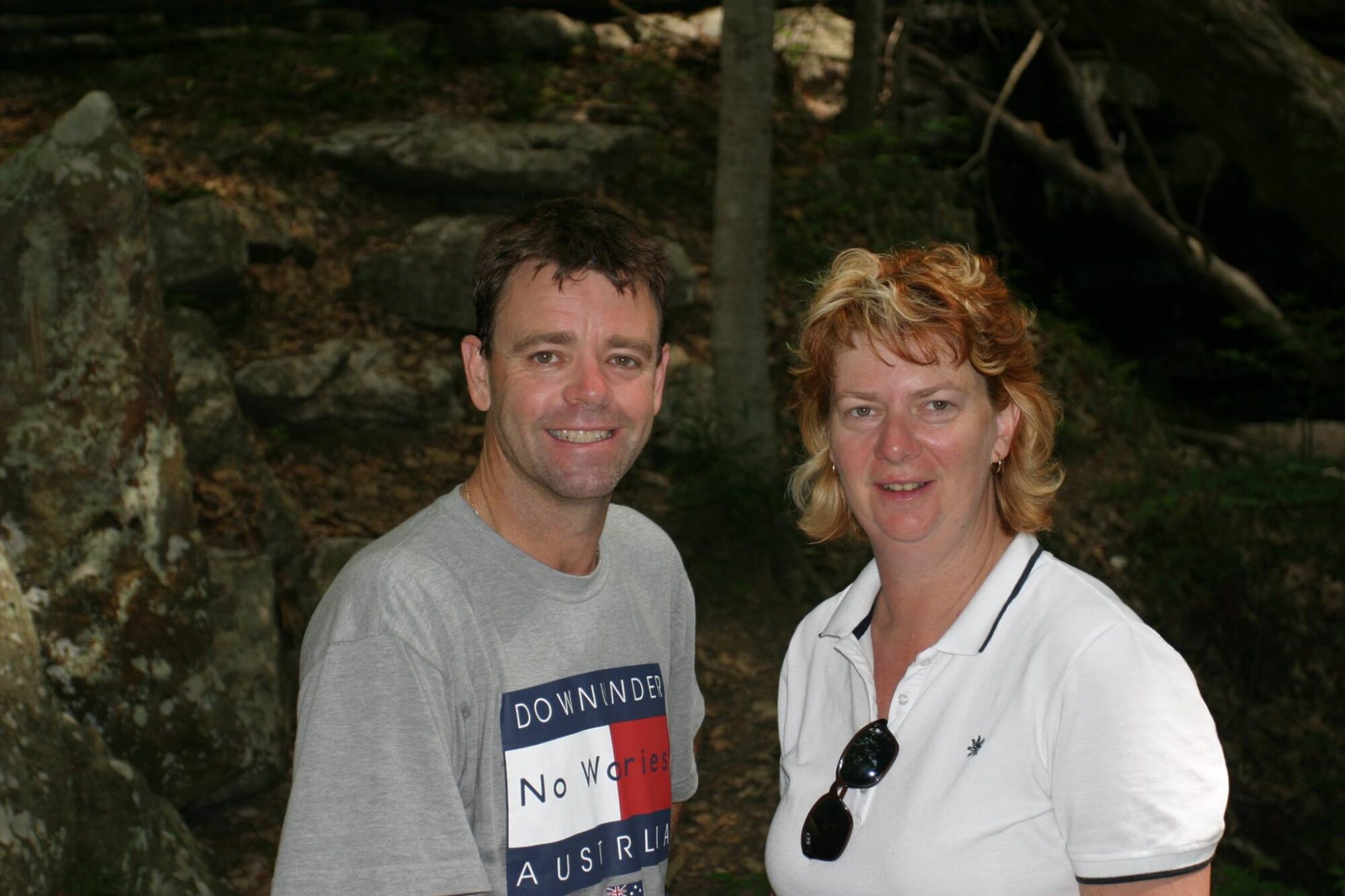 Graham was incredibly generous, kind, whip-smart, fierce in his devotion to Di and Laura, and one of the funniest people I’ve ever known. He and Di were both school teachers, both utterly devoted to education, to serving their schools and communities. They were active in their unions. They were political. They loved nature, loved good food and good drink. They were, in short, a lot like us. We knew that we wanted to maintain our friendship after our return to the States. And we did. The following summer Graham, Di, and Laura came to the States for their winter holiday (Southern Hemisphere and all that) and stayed with us for several days. Another great visit. We had tons of fun, but Graham and I also spent a good deal of time talking. He had just lost his father, something I went through a decade earlier. I can honestly say that even though we were now living literally half a world apart, our friendship had only deepened.
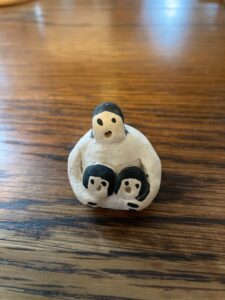 During our tour, we encountered many people selling pottery in front of their homes. And at one table, a mother displayed her wares beside those of her young daughter. I think the girl must have been around 7 or 8, give or take a year, and she had made a few small bowls, seed pots, and dishes. And she had made a tiny storyteller. As one would expect, it was quite crude compared to those we had seen for sale back in Albuquerque (we hadn’t yet been to Santa Fe or Taos), but something about the figure spoke to me. Maybe is was just that the storyteller was so cute. Or maybe it was that the girl herself was so proud of it. Or maybe I saw in this child’s early effort to follow in her mother’s footsteps something akin to my dream of becoming a professional writer. Whatever the reason, I asked the girl how much it cost.
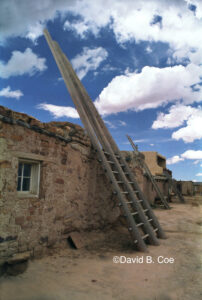 That was a magical day in many ways. Acoma was as beautiful as we had been told, the pale red stone of the Pueblo seeming to glow beneath a deep azure sky, wooden kiva ladders rising above their structures and reaching toward the clouds. At one point, I spotted a rainbow in the clouds overhead — there was no rain, just the prismatic color, which appeared for a moment and then vanished. I think I was the only one on the tour who saw it. I believed that, together, the rainbow and my little storyteller were omens, signs that my dream would, in fact, come to pass.
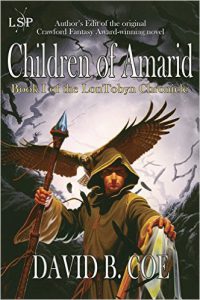 Two months later, I got my first contract from Tor Books. Children of Amarid wasn’t published for another three years — that first book needed a lot of editorial work. But I was on my way.
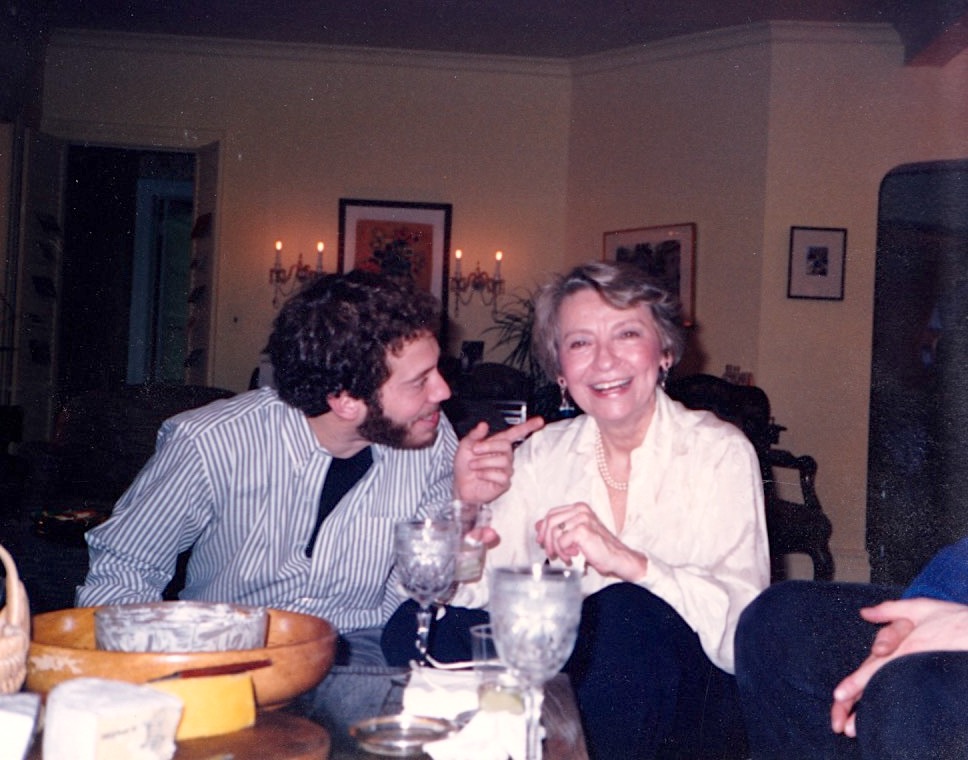 Yesterday would have been my mother’s birthday — her 101st. I’ve written about her, and my dad, quit a bit in this space, though I haven’t written about my mother in a couple of years. She was smart and funny, classy and beautiful, quietly ambitious and deeply accomplished. She doted on her children and was, in turn, doted on by my father. She loved to travel and was passionate to the point of reverence about literature and the arts.