I just reread my first post of the year, when I first discussed my weekly blogging plans, and my goals for the months to come. I closed the post with “Happy 2020. May it be your best year yet.”
How did that work out…?
This is likely my last post of the year, and my final Writing-Tip Wednesday post before I shift Wednesdays to a slightly broader format. It’s also a slightly longer post than usual; I hope you’ll stick with it. I have posted about a vast array of topics over the past fifty-one weeks, and all of them have dealt with creativity in one way or another. At times, the creative elements of my posts have been explicit and obvious; at other times, when discussing the business and the state of the market, the connections have been less clear. But always it comes back to the act of creating, the process of harnessing the imagination in order to produce… something.
Creativity is integral to who I am, to the life I lead. I consider myself fortunate beyond words in this regard. And I’m not just talking about writing. If you follow my blog or my social media, then you know that I am also an avid photographer and a longtime musician, and I’m passionate about all of my creative endeavors. But I do each of these things for different reasons, and I think this speaks to something all writers ought to consider.
Why do we create?
I like to tell people that I wrote my first book when I was six. It wasn’t much of a book — a few sheets of paper on which I had scrawled a story and scribbled illustrations, sandwiched between a couple of pieces of colored construction paper and bound with yellow yarn. But it was, to my mind, as much a book as all the titles on my shelves. All through my childhood, there was nothing I enjoyed more in school than creative writing. Any opportunity we were given to sit quietly and write was, for me, like the most glorious sort of recess.
In junior high, my classmates and I were assigned to keep a creative journal. For an entire semester, we were to write every night — or as close to it as we could manage — and we were free to write whatever we wanted. I still have mine. I did write every night. I wrote short stories and poems and my reflections on the world as I saw it. I LOVED keeping that journal.
All through high school and college, I wrote. I saw the world through a writer’s eyes. Always, my first thought upon seeing a sunset, or enjoying a meal, or even dealing with emotional problems, was “How would I write this?”
My love of storytelling, of the creative alchemy we perform when converting emotion and sensation into words, still drives me, challenges me, fills me with joy and satisfaction (when it’s not frustrating me and making me want to chuck my computer through a window).
But, of course, my writing is also my job, and I have to think about it as such. That’s fine. I am so lucky to be able earn money doing what I love; I can hardly complain. At this point, though, I write to publish. Anything I work on for any amount of time, I expect to sell. If I don’t, then that piece of writing has…failed in some respect. That sounds harsh, I know, but it’s true. It also sounds mercenary, and that, I fear, is unavoidable. I can be passionate about my work, and also want to make money off of it. I make no apologies for that.
I feel quite differently about my photography. I am, I believe, a very good photographer. I have spent years studying photography, teaching myself techniques, making myself see my surroundings with an artist’s eye. I was drawn to photography early in life, in part, I have to admit, out of jealousy. My older brother, Jim, is a renowned and immensely talented painter. He was a bit of prodigy — his talent emerged in his early teens and as passionate as I am about writing, that’s how he continues to be about visual art. I wanted to creative images, too, but I have never been able to draw. Oh, I tried. But I’m terrible. There’s no other way to put it.
When I was thirteen, I asked for a camera, thinking that perhaps photography would offer me a path to visual artistic expression. My early efforts didn’t amount to much, and eventually I stopped trying. About fifteen years ago, though, I decided to try again. I dedicated myself to learning how to shoot, how to see, how to frame. The results have been deeply satisfying. I have sold a few photos and I’ve had work in local galleries. But while I have been pleased by these moments of public attention, I mostly capture images for myself. Nancy and I recently enlarged and framed several of my best images and they are now gracing the walls of our home. I have also produced a coffee-table photo book that I shared with just a few friends and family members. And my computer’s screen saver is a slide show of my best images.
I get as much joy out of seeing my own images in my house, in that book, on my computer, as I have from any sale of a photo. To be honest, I took nearly as much pride in hanging those images as I have in selling a new novel. I do it for me, and that’s enough.
And I feel still another sort of love and pride for my music. I have been playing guitar for more than forty years. I have always been able to sing, and for a while, in elementary school and junior high, I was content to express that talent in school musicals. But at some point I figured out that playing guitar might attract the notice of girls. (As it turns out, guitars weren’t enough. I also needed charm, height, and good looks, none of which I possessed. But hey, I learned to play guitar.)
I still love to play — for myself, for Nancy, occasionally for and with friends. Playing for my girls when they were young was truly a joy. I’ve never been very good at writing songs. I tried. I wrote a very few decent tunes in college, but I had a couple of friends who wrote amazing music, and my inability to craft songs as good as theirs, and as good as I thought mine should be as well, frustrated me. At some point, I stopped trying. Today, most of my playing is fairly derivative. I hear a song I like and I teach myself to play it. It’s fun. I get to recreate songs I admire, either for a small audience or for me. The truth is, though, I’m not adding much to the world’s music. I’m just another guy learning to play another James Taylor tune.
And so I ask again, why do we create?
I create stories for my livelihood. I create photos that are utterly original, but only for my friends, family, and me. I create music in order to pay homage to something I love, and to entertain myself.
I have tried throughout this year to gear my writing tips to writers of every ability level and every aspiration. Some of you won’t be satisfied with your writing until you’ve published a story, or a novel, or a series, or a bunch of series. I get that.
Some of you write because you want to craft the best story you can, and if you publish it, great. If you don’t, if the only people who read it are your friends and family, that’s okay, too. The process itself is the point. Your goal is to create the best piece you can.
And some of you take great joy in writing fan fiction, in writing homages to characters and storylines that you admire and want to be part of in some way. That’s great, too.
There is no single right answer to “Why do we create?” No matter where you fall on the continuum of creativity I’m describing here, you can learn to be a better writer, you can take satisfaction in the act of creation, and you can engage in that alchemy I mentioned earlier.
Because there is something truly magical in creativity — in the simple act of harnessing the imagination — something that has nothing at all to do with money or reviews.
I wish you joy and inspiration in all your endeavors.
And, of course, keep writing.









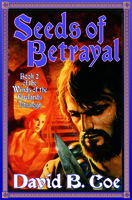
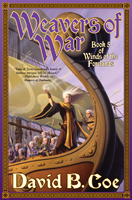 For the Winds of the Forelands series (Rules of Ascension, Seeds of Betrayal, Bonds of Vengeance, Shapers of Darkness, Weavers of War) , I created what is without a doubt the most complex “calendar” I’ve ever undertaken for any project. For those of you not familiar with the world, I’ll give a very brief description. The world has two moons, Ilias and Panya, the Lovers, who chase each other across the sky. Each turn (month) has one night when both moons are full (the Night of Two Moons) and one night when both moons are dark (Pitch Night). Each turn is also named for a god or goddess, and so each Night of Two Moons and each Pitch Night has a special meaning.
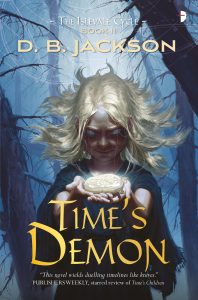 I did something similar for the Islevale Cycle novels (Time’s Children, Time’s Demon, Time’s Assassin). In this world there are two primary deities, Kheraya (female) and Sipar (male), and the calendar is structured around them. It begins with the spring equinox — Kheraya’s Emergence, a day and night of enhanced magickal power and sensuality. The spring months are known as Kheraya’s Stirring, Kheraya’s Waking, Kheraya’s Ascent. The summer solstice is called Kheraya Ascendent, a day of feasts, celebration, and gift-giving. This is followed by the hot months of summer: Kheraya’s Descent, Fading, and Settling.